
Campbell County Court Records After Arrest
The local path usually runs from arrest to booking at the Campbell County Detention Center, then to a first appearance or arraignment in District Court. After the arrest, the prosecutor reviews the facts and the charge record begins to move through court. District Court handles misdemeanors, violations, traffic offenses, arraignments, and felony probable-cause hearings. Felonies move toward Circuit Court by indictment or information after probable cause or prosecutor action.
The court record is not the same as the booking record. CCDC says roster arrest information reflects charged offenses for people in custody and that court accuracy should be verified with local District and Circuit Courts. For custody and booking fields, use Campbell County jail inmate records. For booking photos, use the Campbell County jail mugshots page. For the filed case, start with the Kentucky Court of Justice and the Campbell County Circuit Court Clerk.
The Kentucky Court of Justice Campbell County page lists the courthouse, clerk, judges, hours, and records note for the county.
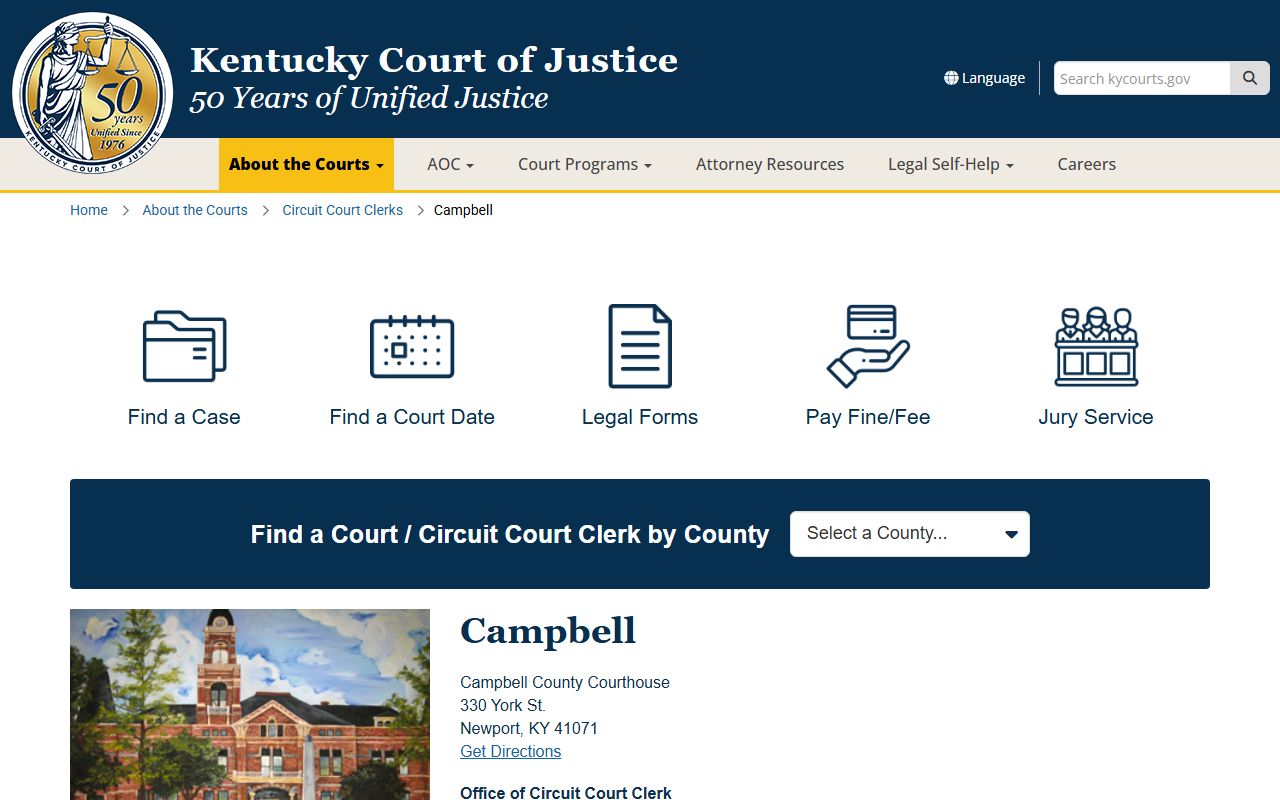
That page is the local court starting point when a jail arrest has moved into a District Court or Circuit Court case.
Find Campbell County Court Records After Arrest
Online access begins with the Kentucky docket portal for date-based docket checks and KYeCourts or CourtNet for registered case access. Official copies and older records still route through the Office of Circuit Court Clerk at Campbell County Courthouse, 330 York St., Newport, KY 41071. The clerk is Taunya Nolan Jack, and the office phone is (859) 292-6314, with District Court at press 1 and Circuit Court at press 2. Published hours are Monday-Friday 8 a.m.-4 p.m.
- Check the Kentucky Court of Justice dockets portal by division, date, courtroom, subdivision, and county.
- If the docket points to a case, contact the Campbell County Circuit Court Clerk for the official file or copies.
- Use KYeCourts or CourtNet only if registration and access rules apply to the user.
- Compare the court charges with the CCDC booking charge because the prosecutor may amend or dismiss counts.
- If the record is older or stored offsite, ask the clerk for case or file locator numbers for the State Records Center.
The statewide court records request page says the Administrative Office of the Courts does not maintain court case records for direct access. Requests start with the clerk of the court that heard the case. For State Records Center files, the requester needs case or file locator numbers and may contact state.records@ky.gov or 502-564-3617.
Campbell County Court Search Fields
The docket portal is useful for hearing dates, not as a full certified case file. The KYeCourts login is broader, but access is gated. For many people, the most reliable sequence is docket check, clerk call, then an official copy request if the docket confirms the case.
| Portal | Fields or Controls | Access Notes |
|---|---|---|
| Kentucky dockets | Division, date, courtroom, county, subdivision, submit | Free docket view, not an official docket and subject to change. |
| KYeCourts/CourtNet | Username, password, register, account recovery | Login required for access to Kentucky court case applications. |
| Clerk records | Call, visit, or request copies through the clerk | Best source for official copies, older files, and retained records. |
The manifest includes the Kentucky docket page, which shows the controls used for a date and county search.
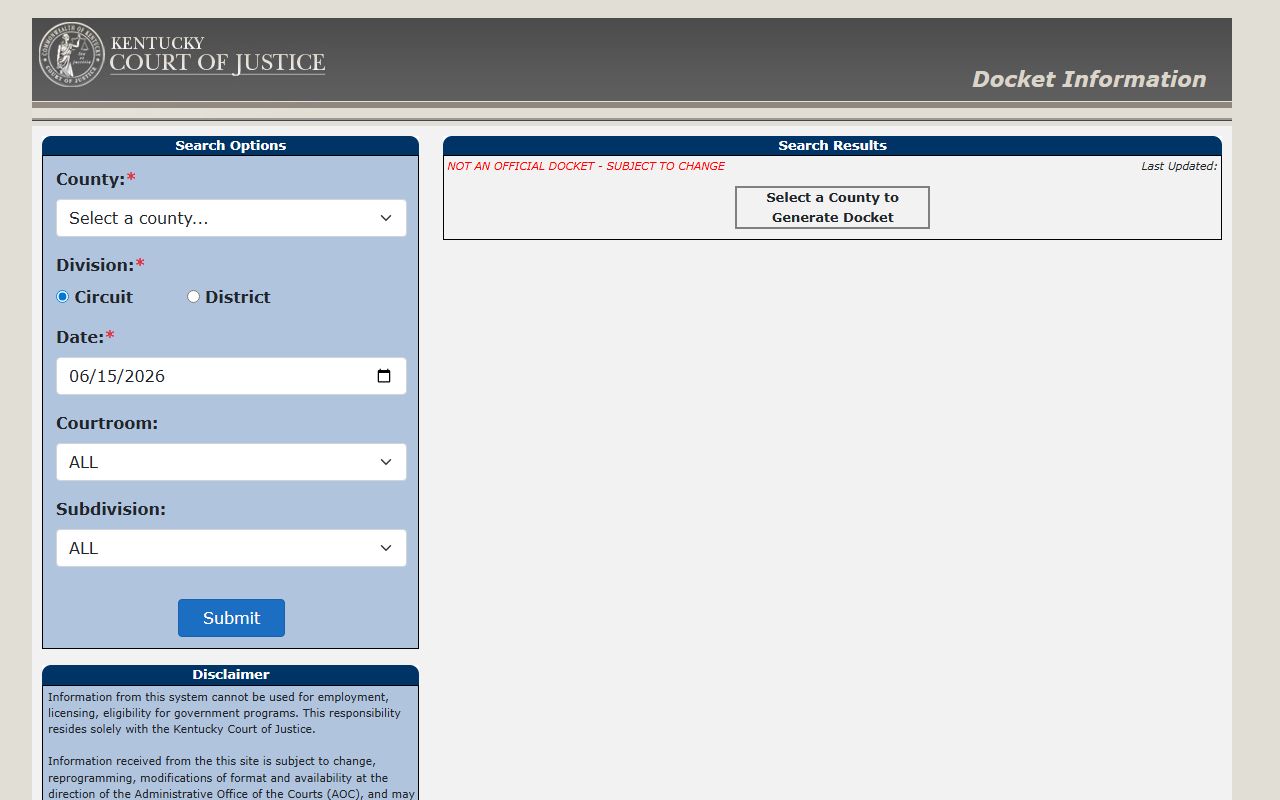
Use that docket screen to locate a hearing before asking the clerk for a certified or complete record.
Charges Filed After Jail Arrest
After a Campbell County jail arrest, the court record may start or change through several charging documents. A complaint can begin a misdemeanor or early felony process. An information is a prosecutor-filed charging document used in many felony paths. An indictment follows grand jury action. The document type matters because it tells the reader where the charge came from and why a roster charge may not match the later court charge.
| Document | Who Uses It | What It Means |
|---|---|---|
| Complaint | Officer or prosecutor | Starts many District Court matters and states the alleged offense. |
| Information | Prosecutor | Files felony charges without a grand-jury indictment where allowed. |
| Indictment | Grand jury | Moves a felony case into Circuit Court after grand jury action. |
Kentucky uses county attorneys and commonwealth's attorneys rather than a district attorney title. Campbell County Attorney Steve Franzen's office prosecutes adult misdemeanors and violations and handles felony cases through the preliminary-hearing stage. The 17th Circuit Commonwealth's Attorney handles felony prosecution, and official listings name Hon. Mike Zimmerman at 601 Washington Street, Suite 210, Newport, KY 41071, phone (859) 292-6490.
Court Charge Status After Arrest
Charge status changes as the court record moves. Pending means the count remains open. Amended means the prosecutor or court changed the count. Dismissed means that count is no longer being pursued in that case, although dismissal should be read with the full docket. Convicted means there has been a guilty plea, verdict, or other conviction entry. A no-bond hold, detainer, or other agency hold can keep a person in custody even when a local bond is posted.
| Status | Plain Meaning | Where to Verify |
|---|---|---|
| Pending | The charge remains open. | Docket or clerk record. |
| Amended | The original count changed. | Court order or prosecutor filing. |
| Dismissed | The count was dropped in that case. | Disposition entry and full docket. |
| Convicted | A conviction was entered. | Final judgment or sentencing record. |
| Held | Another hold or detainer may block release. | CCDC, court, or holding agency. |
Note: A booking charge is an intake record; a conviction is a court outcome that must be verified in the case file.
Bond Records After Campbell County Arrest
Bond appears in both jail and court workflows. CCDC says cash bond is posted at District Court, 330 York St., Newport, between 8 a.m. and 4 p.m. Monday-Friday. After paying at the District Court Clerk's Office, the person posting bond brings the receipt to CCDC at 601 Central Ave. After court hours, on holidays, or on weekends, bond is posted at the Detention Center with valid ID, the correct cash amount, and a $30 fee added to the bond. The jail does not give change and tells people to call (859) 431-4611 for the exact cash amount.
Property bonds are not processed by CCDC and must be posted at District Court. Special or nonmonetary bonds may require release to a responsible adult. A PR bond means personal recognizance release without a cash deposit. A local bond does not clear a federal, ICE, parole, or other-county hold. That is why court records after a jail arrest should always be checked beside the custody status.
- PR bond
- Release on personal recognizance without a cash payment.
- Detainer
- A request or hold from another agency that can delay release.
- Special bond
- A noncash bond with court-set conditions, sometimes involving a responsible adult.
Warrants and Court Records After Arrest
No official online active-warrant search for Campbell County was located. The Campbell County Sheriff's FAQ says warrant information is not provided by phone. A person seeking warrant information from the sheriff must go in person, present photo ID, and ask a deputy to check. Once a warrant is served and the person is booked, the CCDC roster may show current custody and warrant or charge fields if those fields are enabled.
The sheriff's role is process and warrants, while the jail is run by the elected jailer. Kentucky's structure matters here. Sheriff Mike Jansen's office handles civil and criminal process and court security, but CCDC records and custody records route through the Detention Center. Bench-warrant and case-status questions may also route to District or Circuit Court depending on the case.
Charge Conviction Sealed Expunged
Campbell County court records after arrest can show several legal states at once. A person can be booked on one charge, prosecuted on another, and later have a count dismissed or amended. Sealing and expungement are also separate from ordinary roster updates. Kentucky law provides expungement procedures for acquittals, dismissals not exchanged for guilty pleas, and charges that do not result in indictment or information.
| Term | Meaning | Why It Matters |
|---|---|---|
| Charge | An allegation filed or listed in court. | It is not proof of guilt. |
| Conviction | A guilty plea, verdict, or conviction entry. | It affects sentencing and background records. |
| Sealed | Access is restricted by court rule or order. | Public viewers may not see the full record. |
| Expunged | A qualifying record is cleared under law. | Use the court process, not a jail roster request alone. |
Kentucky Access Rules After Arrest
KRS 61.871 states Kentucky's open-records policy, and KRS 61.872 describes how eligible requesters may submit written public-records requests. For court records, use the clerk process. For jail booking records, use the CCDC open-records process. For expungement of acquittals, dismissals, and cases not resulting in indictment or information, review KRS 431.076.
Important: Public court data may lag behind a hearing, so verify custody, bond, and disposition with the clerk or originating agency.
Public Record Search
Sponsored Results